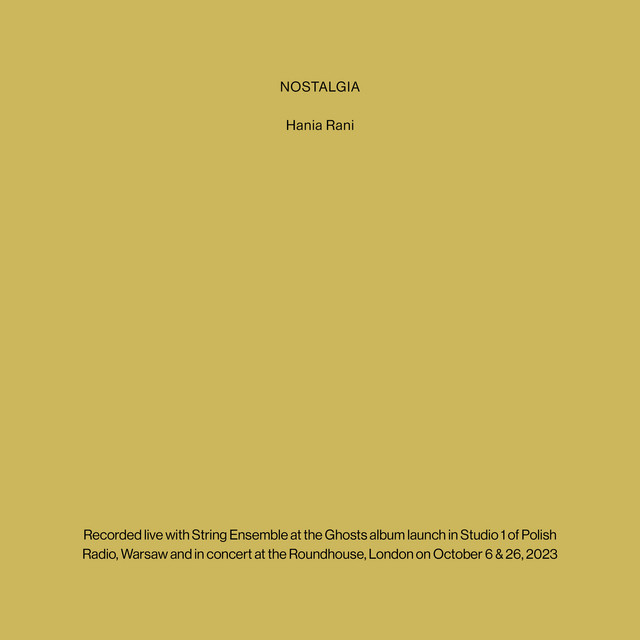
Nostalgia
by Hania Rani
This album has been added to 1 public list:
-

On Vinyl
Greg- Root Genre: Classical / Art Music
- Primary Branch: Contemporary Classical / Modern Classical
- Secondary Influences: Ambient, Electronic, Minimalism, Art Pop, Jazz
- Textural Identity: Expansive, luminous and cinematic — piano, synthesizers, voice, strings and double bass captured live with a strong sense of space and resonance
- Energy Axis: Low → Medium-High (often contemplative, but with much larger dynamic and emotional swells than Esja)
Nostalgia is Rani’s first full live album, recorded primarily at Studio 1 of Polish Radio in Warsaw, with the closing title track recorded at London’s Roundhouse. Gondwana presents it as a live reimagining of material around Ghosts, and the performances add strings and a broader ensemble palette to Rani’s piano, synths and vocals. :chatgpt-content-reference{index=“0”}
Compared with Esja, I would keep the same Classical / Art Music root but broaden the branch. Esja was essentially minimalist solo-piano music; Nostalgia sits much closer to Contemporary / Modern Classical because piano is now integrated with electronics, voice and string arrangements. The electronic influence is substantial—“24.03” has even been compared to early Tangerine Dream—but it still feels secondary to Rani’s compositional and ensemble language. :chatgpt-content-reference{index=“1”}
The interesting thing is that these are not merely live reproductions of Ghosts. The strings in particular give pieces such as “Thin Line” and “Komeda” a different emotional scale, and contemporary reviews noted how dramatically the live arrangements reshape the originals. :chatgpt-content-reference{index=“2”}
Small review: Nostalgia makes Hania Rani sound much larger than the intimate pianist you hear on Esja. The piano is still the emotional anchor, but now it sits inside an environment of synth drones, voice and strings that can expand from near-silence into genuinely overwhelming crescendos. “Thin Line” and “Komeda” particularly benefit from the live ensemble, while “24.03” shows how naturally her minimalism can drift toward ambient electronics. Yet the closing “Nostalgia” brings everything back to the intimacy of the piano. It is a very good snapshot of Rani’s evolution: the minimalist pianist of Esja transformed into a composer-performer working across classical and electronic space. :chatgpt-content-reference{index=“3”}
Collection shorthand: Classical / Art Music → Contemporary Classical / Modern Classical.

Do you like albums?
Want to make a list?
It’s free & easy &
the Whale is nice!
Learn more