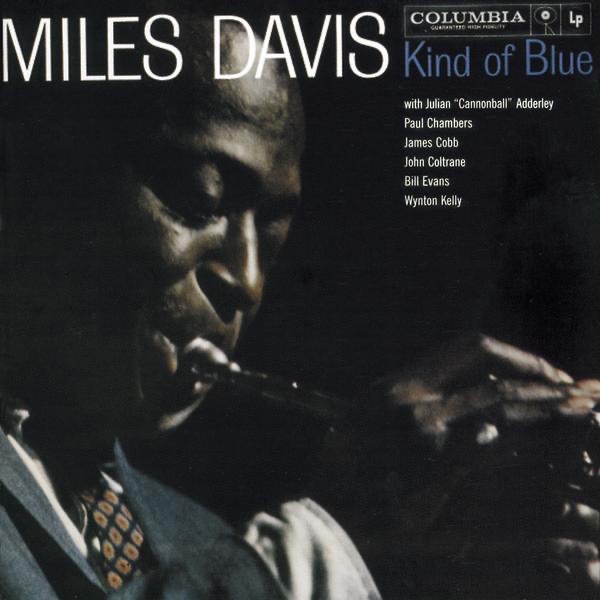
Kind Of Blue
by Miles Davis
This album has been added to 22 private lists and 41 public lists:
-

On Vinyl
Greg- Root Genre: Jazz
- Primary Branch: Modal Jazz
- Secondary Influences: Cool Jazz, Hard Bop, Blues
- Textural Identity: Spacious, lyrical and understated — trumpet, alto/tenor saxophones, piano, upright bass and drums using open harmonic frameworks that give the soloists unusual freedom
- Energy Axis: Low → Medium (calm, poised and reflective, with intensity coming from phrasing and interaction rather than speed or volume)
Kind of Blue is one of the clearest examples of Modal Jazz as a primary branch. Instead of relying mainly on rapid chord changes, Miles Davis built much of the album around modes and comparatively static harmonic fields, giving the musicians more room to develop melodic ideas.
The lineup is exceptional: Miles Davis, John Coltrane, Cannonball Adderley, Bill Evans/Wynton Kelly, Paul Chambers and Jimmy Cobb. What is remarkable is how restrained everyone sounds. Coltrane can be fiery, Adderley bluesy and extroverted, Evans impressionistic, yet the record holds them all inside the same cool, spacious atmosphere.
Small review: Kind of Blue is famous enough that it is easy to forget how radical its simplicity is. “So What” creates an enormous amount of space from very little harmonic material; “Freddie Freeloader” brings the album closer to blues and hard bop; “Blue in Green” is almost weightless; and “All Blues” turns a repeating 6/8 structure into something hypnotic and endlessly fluid. The album’s greatness is not just in the solos but in the amount of air around them. Every note seems to have room to resonate.
Collection shorthand: Jazz → Modal Jazz.
-

-

1958-1959
JamesNo jazz album has become more universally beloved, and few deserve it more. By simplifying harmonic structures and emphasizing modal improvisation, Miles Davis opened vast new possibilities for jazz. Every player contributes something essential, from Coltrane's searching solos to Bill Evans' impressionistic piano. The music feels spacious, conversational, and remarkably free despite its elegance. Nearly seventy years later, it still sounds fresh rather than historical.
-

-

2025 - Week 24: Rob's Listening Log #11
Rob RyanI need to listen to more jazz...
-


2025
PL⭐️⭐️⭐️⭐️⭐️
Jazzin kuninkaan meditatiivista mestaruutta.
-


Winner Spinner, Chicken Dinner
TannerThe Rolex of jazz albums. Recommended when raining outside
-

2024-04
vertino1001albums:668
-


1001Albums
Neil Hopkinsn 1959 Miles Davis decided to do something different, moving away from hard bop jazz. He assembled a crew of some of the best musicians around, gave them each a set of scales to improvise around, then lit the metaphorical blue touch paper. The result is like listening to a conversation as music is built up in real time with each player contributing to the piece. Music like this really should be heard live, but this recording is probably as good as it gets.
-

Marvin's top twenty-ish albums
MarvinOne of the preeminent jazz albums by preeminent jazz musicians.
The night I watched the video "Sting: Bring on the Night" [1985?] and was introduced to the power of jazz music, we went to Tower Records in Anaheim and I asked one of the workers, "If I want to buy my first jazz album, what should it be?" This was it. -

My Top 10 of the Rolling Stone Top 50
BarryThere's a reason this is a classic.
-

-

-

-

-

-

-

-

-

-

-

-

-

-

-

-

-

-

-

-

-

-


-

-

-

-

-

-

-

-







Do you like albums?
Want to make a list?
It’s free & easy &
the Whale is nice!
Learn more